

- July 22, 2026
- By
- Blog
A light that flickers once when another appliance starts may be annoying. A light that repeatedly dims, brightens or flashes without an obvious reason needs attention. When homeowners ask what causes flickering lights in house, the answer ranges from a simple loose bulb to a fault in the electrical installation that should be dealt with promptly.
The key is noticing the pattern. Does one fitting flicker, or do lights across several rooms change brightness? Does it happen when the washing machine, shower or kettle is running? Those details help identify whether the issue is local to one light fitting or part of a wider supply problem.
What causes flickering lights in a house?
A loose bulb, lamp or fitting connection
If just one light is flickering, start with the simplest possibility. The bulb may not be fully seated in its holder, particularly with screw-cap bulbs that have worked loose over time. With the light switched off and cooled down, check that the bulb is correctly fitted. If it still flickers, try a known-good replacement of the correct type and rating.
The fault may also be inside the light fitting. Loose terminals, heat damage in a lampholder or a failing integrated LED driver can all interrupt the connection momentarily. Do not remove a fitting or touch wiring to investigate. A qualified electrician can safely isolate the circuit, inspect the connections and repair or replace the faulty component.
Incompatible or failing LED bulbs
LED lighting uses far less electricity than older incandescent lamps, but it can be less forgiving of unsuitable dimmers and poor-quality components. An LED bulb may flicker because it is not designed to work with the existing dimmer switch, or because the dimmer is intended for older-style lamps and cannot manage a small LED load properly.
This is especially common after changing only some bulbs on a dimmed circuit. Using dimmable LED lamps with a compatible LED-rated dimmer usually resolves the issue. It depends on the fitting and the dimmer, though, so replacement should be selected carefully rather than by wattage alone.
A flickering LED that is not connected to a dimmer may simply be reaching the end of its life. If several new bulbs from the same batch begin flickering, the problem is more likely to be the fitting, switch or circuit than the bulbs themselves.
A worn switch or loose connection on the lighting circuit
A damaged switch can make a light flicker when it is touched, pressed or moved. You may notice crackling, a warm faceplate, intermittent operation or a switch that feels loose. These are not issues to ignore. A poor connection creates resistance and heat, which can damage accessories and, in serious cases, increase fire risk.
Connections can also loosen behind a ceiling rose, junction box or downlight over years of use, movement and temperature changes. Older properties may have previous alterations concealed above ceilings or beneath floors. Fault finding is the safest way to identify the exact point of failure without making assumptions or disturbing live parts.
Voltage drop when large appliances start
A brief, slight dip in brightness when a high-demand appliance starts can happen in some homes. Motors and heating elements can draw a larger current at start-up. Common examples include a fridge compressor, extractor fan, washing machine, tumble dryer, electric shower or central-heating pump.
One quick flicker is different from repeated or pronounced dimming. If lights noticeably dip every time an appliance operates, especially if sockets, switches or cables are warm, an electrician should assess the circuits and connections. The appliance could have a fault, the circuit may be overloaded, or there may be a supply or consumer unit issue that needs investigation.
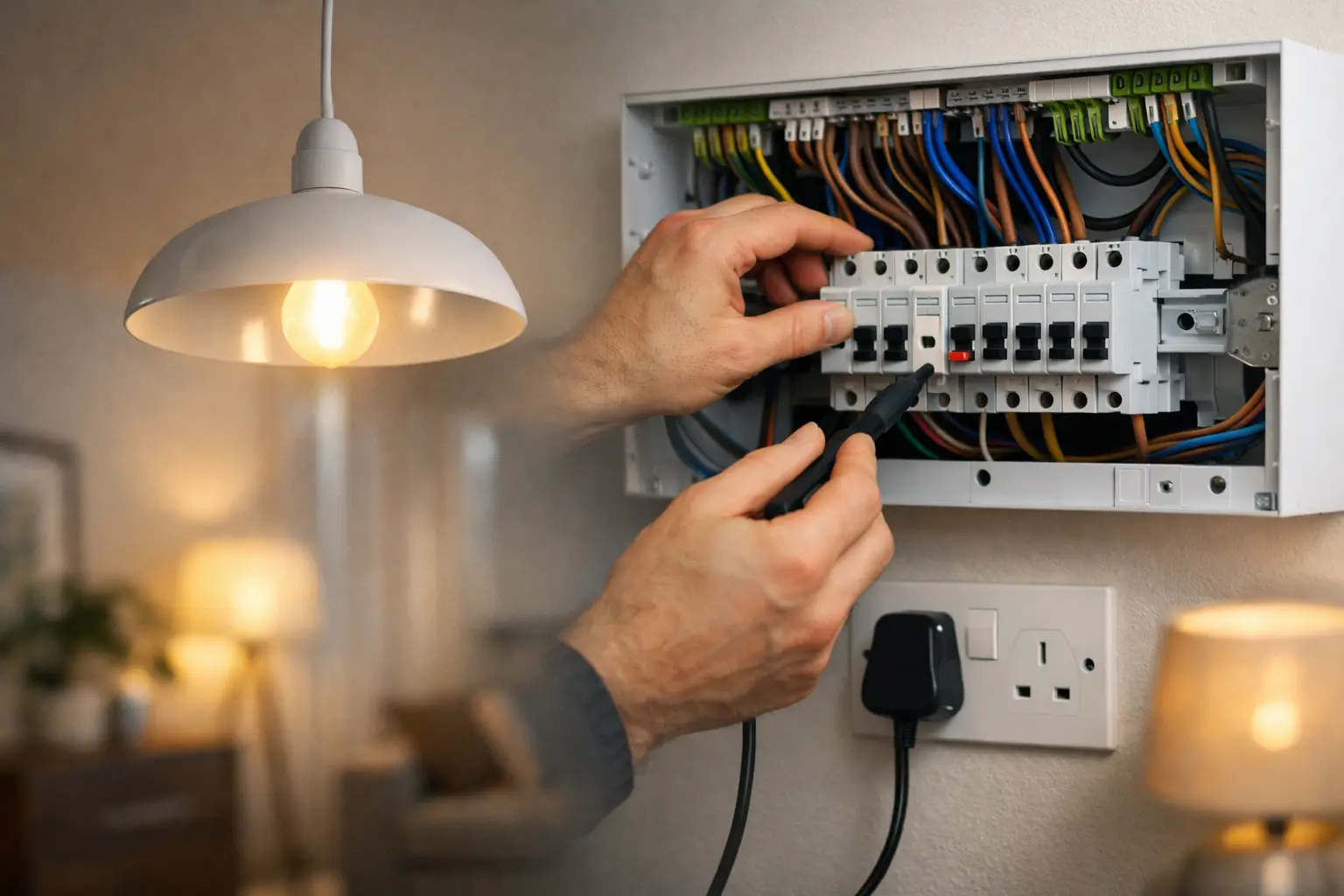
Problems at the consumer unit or main supply
Lights flickering in more than one room can point to a wider problem. Loose connections at the consumer unit, meter position, main earthing arrangement or incoming supply may cause unstable voltage. These faults need urgent professional attention because they affect more than one circuit and may involve equipment that should only be accessed by the relevant qualified person or electricity network operator.
Pay particular attention if lights become unusually bright as well as dim. Sudden changes in brightness throughout the property can indicate a neutral connection fault. This can expose appliances to incorrect voltage and cause damage. Switch off sensitive equipment if it is safe to do so, avoid touching electrical equipment unnecessarily, and arrange urgent help.
In a terrace, semi-detached house or block of flats, it is also useful to ask whether nearby properties have experienced the same problem. If they have, the fault may be on the local network rather than inside your home. Your electricity supplier or distribution network operator can advise on supply-side faults, while an electrician can check your installation first where appropriate.
Ageing wiring or previous poor-quality work
Flickering lights are sometimes one symptom of an older installation that needs closer inspection. Age alone does not automatically mean wiring is unsafe, but worn cable insulation, dated accessories, overloaded circuits and alterations carried out without proper testing can create reliability and safety concerns.
Other signs that support a call for an inspection include regularly tripping circuit breakers, burning smells, buzzing accessories, discoloured sockets or switches, shocks or tingles from metal fittings, and a consumer unit with rewireable fuses. Landlords should take these signs seriously as part of their duty to maintain a safe electrical installation and keep a valid Electrical Installation Condition Report where required.
When flickering lights are an emergency
Switch off the affected circuit at the consumer unit if you can do so safely, and call an emergency electrician, if flickering is accompanied by burning, smoke, sparks, buzzing, a hot fitting, a burning-plastic smell or signs of scorching. Do not keep resetting a tripped breaker to see whether it holds. The breaker is responding to a fault, and repeated resetting can make the situation worse.
Urgent action is also sensible when lights throughout the property are fluctuating, appliances are behaving oddly, or the fault follows water ingress from a leak. Keep clear of any wet electrical equipment and do not attempt to dry, dismantle or repair it yourself.
What you can safely check before calling an electrician
There are a few useful observations you can make without taking anything apart. Note which lights are affected, whether the fault is constant or intermittent, and what was running at the time. Check whether a replacement bulb changes the result, provided the fitting is switched off and cool before you handle it.
You can also look for visible warning signs from a safe distance: damaged light fittings, loose switch plates, staining around ceiling lights or a breaker that has tripped. Avoid opening the consumer unit, removing faceplates, or tightening electrical terminals. Electrical fault finding is not guesswork, and a loose wire can still be live even when a light is not working.
Clear information helps an electrician diagnose the fault efficiently. A short video of the flicker, details of recent decorating or electrical work, and a list of appliances that trigger the problem can all be useful. It can reduce time on site and help ensure the right repair is made first time.
Getting the right repair, not just a temporary fix
The correct solution may be as straightforward as replacing an incompatible dimmer or repairing a loose fitting. In other cases, testing may reveal a damaged cable, overloaded circuit, failing consumer unit connection or supply fault. The repair should match the cause, then be tested to confirm the circuit is safe and working correctly.
Gerrard’s Electrical Solutions provides practical fault finding and repairs for homeowners and landlords around Chester, with clear advice on what has been found and what needs doing next. Work should be completed to current BS 7671 requirements, with safety and a tidy finish treated as part of the job rather than extras.
Flickering lights do not always mean danger, but they should not become part of the background noise of your home. If a bulb change does not solve a single-fitting issue, or the problem affects more than one room, arranging a professional check gives you a clear answer and the reassurance that the fault has been properly dealt with.