

- July 17, 2026
- By
- Blog
A dark side path, rear gate or driveway can make an otherwise secure property feel vulnerable. A well-planned outdoor security lighting installation gives you clear visibility where it counts, deters opportunistic intruders and makes arriving home after dark more comfortable. The best results are not about fitting the brightest possible floodlight. They come from sensible positioning, suitable controls and electrical work completed safely.
Outdoor security lighting installation starts with the right purpose
Before choosing a fitting, decide what the light needs to achieve. Security lighting for a driveway may need a wider beam and reliable motion detection. Lighting by a front door is often better as a lower-level, steady light that helps you find keys, see visitors and use the entrance safely. A side passage or garden gate may only need focused light for a short period when someone passes through.
This matters because poor placement can create glare rather than security. A powerful light pointed towards the road, a neighbour’s bedroom or your own windows can be irritating and reduce your ability to see clearly. It can also create deep shadows behind hedges, sheds and bins – exactly the places you may want to keep visible.
Walk the property after dark
The simplest way to plan is to look at the property in the evening. Identify the routes you use, the entrances that are hidden from view and any areas where someone could approach unnoticed. Think about practical jobs too: taking bins out, checking a gate, parking the car or letting the dog into the garden.
For landlords, lighting at shared paths, entrances and parking areas can support a safer, more usable property. The right approach still depends on the layout, the tenancy and whether lighting could disturb neighbouring homes.
Choose the beam, not just the brightness
LED fittings are usually the sensible choice. They use far less electricity than older halogen floodlights, reach full brightness quickly and generally need less maintenance. However, a higher wattage is not automatically better. Light output is measured in lumens, and the correct level depends on the area being covered.
A broad floodlight can suit a large driveway, while a narrower beam works well for a passageway or gate. Warm-white light can feel more welcoming near an entrance, whereas a cooler white may give clearer definition for general security use. A competent electrician can help match the fitting and beam angle to the space rather than leaving you with an overlit garden.
Keep light where it belongs
Fittings should be positioned high enough to be difficult to tamper with, but still accessible for cleaning and future replacement. They need a clear view of the area being covered, without branches, climbing plants or rooflines repeatedly triggering the sensor.
Avoid aiming lights directly at CCTV cameras. Excessive brightness can wash out footage, especially when a camera switches into night mode. It is also worth checking the view from the street and adjacent properties before finalising the angle. A small adjustment can prevent a great deal of nuisance.
Getting motion sensors and timers right
Controls make security lighting useful rather than wasteful. Motion sensors are popular because the light only operates when needed, but they must be set up carefully. A sensor that switches on every time a cat passes, a tree moves or a car travels along the road soon becomes a frustration.
Most quality PIR sensors allow adjustment of sensitivity, detection range and how long the light remains on. A shorter run time can be appropriate for a side path, while a driveway may need a little longer to allow for parking and unloading. The sensor should be directed across the likely route of movement, not straight towards it, as this often improves detection.
Dusk-to-dawn controls provide a different benefit. They are useful for house numbers, porches and entrances that should remain lit throughout the evening. A timer can also provide a predictable lighting pattern when you are away, although it should be used thoughtfully to avoid unnecessary energy use.
Smart controls can add convenience, particularly where you want to adjust schedules from your phone or combine lighting with a wider home-security system. They are not essential for every property. A straightforward, correctly installed PIR fitting is often the most dependable answer for a gate, yard or pathway.
Safe external wiring is not a DIY afterthought
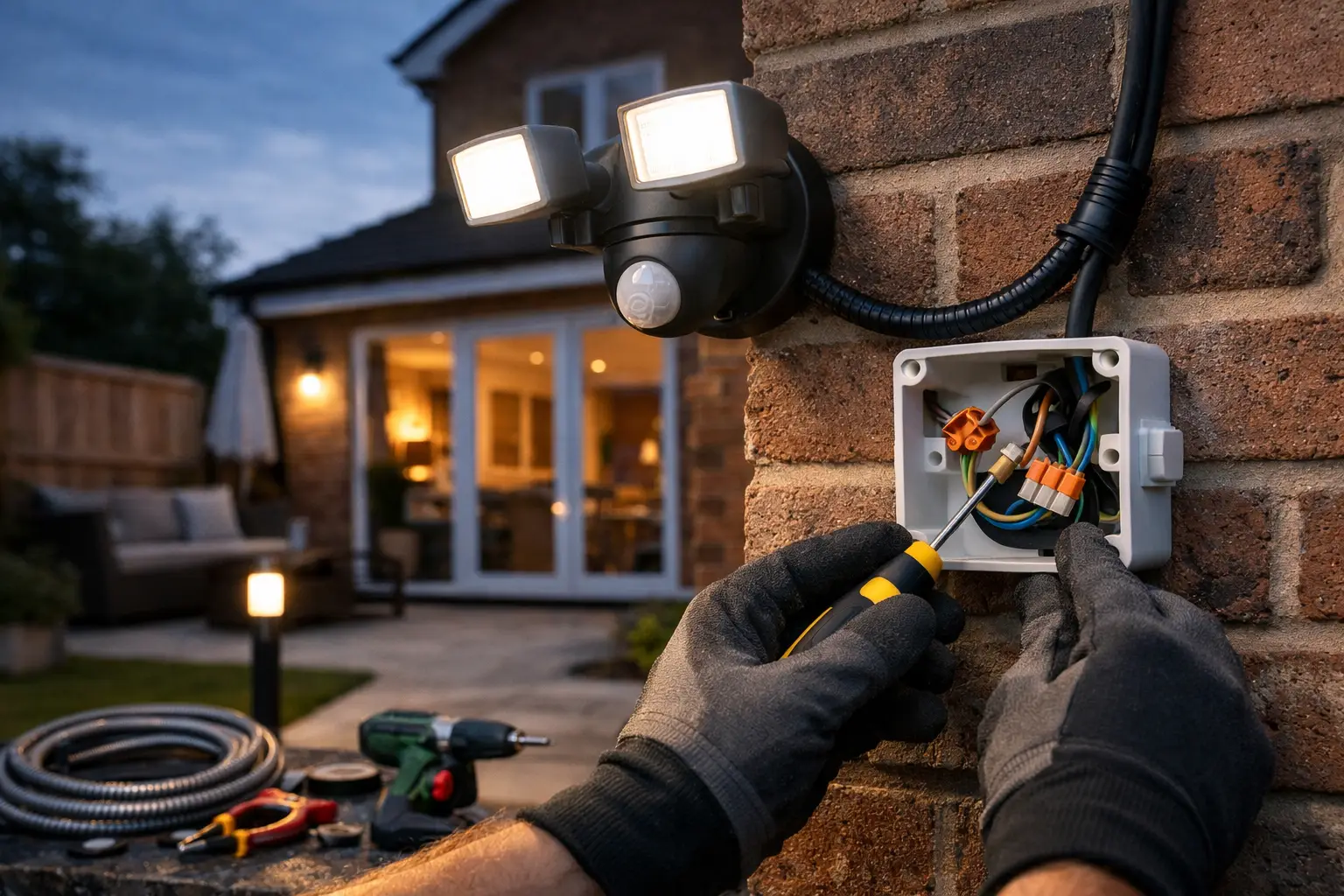
Outdoor electrical work has to cope with rain, frost, sunlight, accidental knocks and changes in temperature. A light fitting may look simple on the wall, but the cable route, connections, protective devices and weatherproofing behind it are just as important.
External fittings and accessories need an appropriate IP rating for their location. This rating indicates how well equipment is protected against dust and water. A fitting exposed to driving rain needs a higher level of protection than one installed beneath a deep porch. Cables and junction boxes must also be suitable for outdoor conditions, securely fixed and protected from damage.
The circuit supplying the lighting should have suitable RCD protection, and all work must be designed and tested in line with BS 7671, the current 18th Edition Wiring Regulations. Depending on the work involved, Building Regulations requirements may also apply. These are not details to overlook simply because the job is outside.
Running a cable through a window, using an indoor extension lead outdoors or making a connection in an unsuitable box creates a real shock and fire risk. Water can enter slowly and unnoticed, causing corrosion or faults long after the light has been fitted. If a light trips the circuit, flickers in wet weather or has visible damaged wiring, stop using it and arrange for the fault to be checked.
When an existing light needs attention
Not every problem requires a completely new installation. A failed lamp, loose sensor setting or worn fitting may be repairable. Equally, older halogen units often consume more power, generate significant heat and can become unreliable after years outside. Replacing an outdated fitting with an LED model can improve coverage while reducing running costs.
An electrician will first check whether the issue is the fitting, sensor, cable, connection or circuit protection. This fault-finding step matters. Replacing a light without identifying water ingress or cable damage may only hide the problem temporarily.
If the existing circuit is old, the consumer unit lacks modern protection or the wiring route is no longer safe, the right answer may be a wider electrical upgrade. Clear advice should explain what is necessary now, what is recommended for safety and what can reasonably wait.
A tidy installation protects the finish of your home
Good outdoor lighting should look intentional in daylight as well as work well at night. That means considering cable routes before drilling, selecting a fitting that suits the building and sealing entry points properly. On brickwork, rendered walls, soffits and timber structures, the installation method should protect the surface and leave a clean finish.
For homes around Chester, exposed locations can be especially demanding during wind-driven rain and winter weather. Choosing suitable equipment and completing proper testing gives the installation a far better chance of remaining reliable through the seasons.
Gerrard’s Electrical Solutions can assess the areas you want to protect, explain the practical options in plain English and complete outdoor lighting work to current standards. You should know where the cables will run, what the controls will do and what the work will cost before installation begins.
A security light is most effective when it helps you see, move and respond confidently without bothering everyone around you. Start with the dark areas that genuinely affect how you use your property, then choose a safe, well-positioned solution built to last.