

- September 12, 2026
- By
- Blog
A smoke alarm can only protect you if it detects a fire early enough to wake everyone and allow a safe escape. This smoke alarm placement guide explains where alarms should go, which areas need a different type of detector, and the common positioning mistakes that can create nuisance alarms or leave a gap in protection.
For homeowners and landlords, getting the layout right matters just as much as choosing a recognised, good-quality alarm. A detector fitted in the wrong place may be regularly silenced, have its battery removed, or fail to detect smoke quickly when it is needed most.
Start with one smoke alarm on every storey
As a sensible minimum, fit a smoke alarm on every level of the home, including loft conversions used as living space. The priority is the escape route: halls, landings and circulation areas that people will use to get out of the property.
In a typical two-storey house, this usually means an alarm in the ground-floor hallway and another on the first-floor landing. In larger homes, extensions, open-plan layouts or properties with more than one stairway may need extra coverage. The aim is to make sure smoke is detected before it makes the main exit route unusable.
For rented homes in England, landlords must provide at least one smoke alarm on each storey used as living accommodation. Requirements can differ elsewhere in the UK, and the correct arrangement will depend on the property and applicable local rules. Meeting the minimum is not always the same as providing the best protection, particularly in a larger or higher-risk home.
The best position: on the ceiling, away from corners
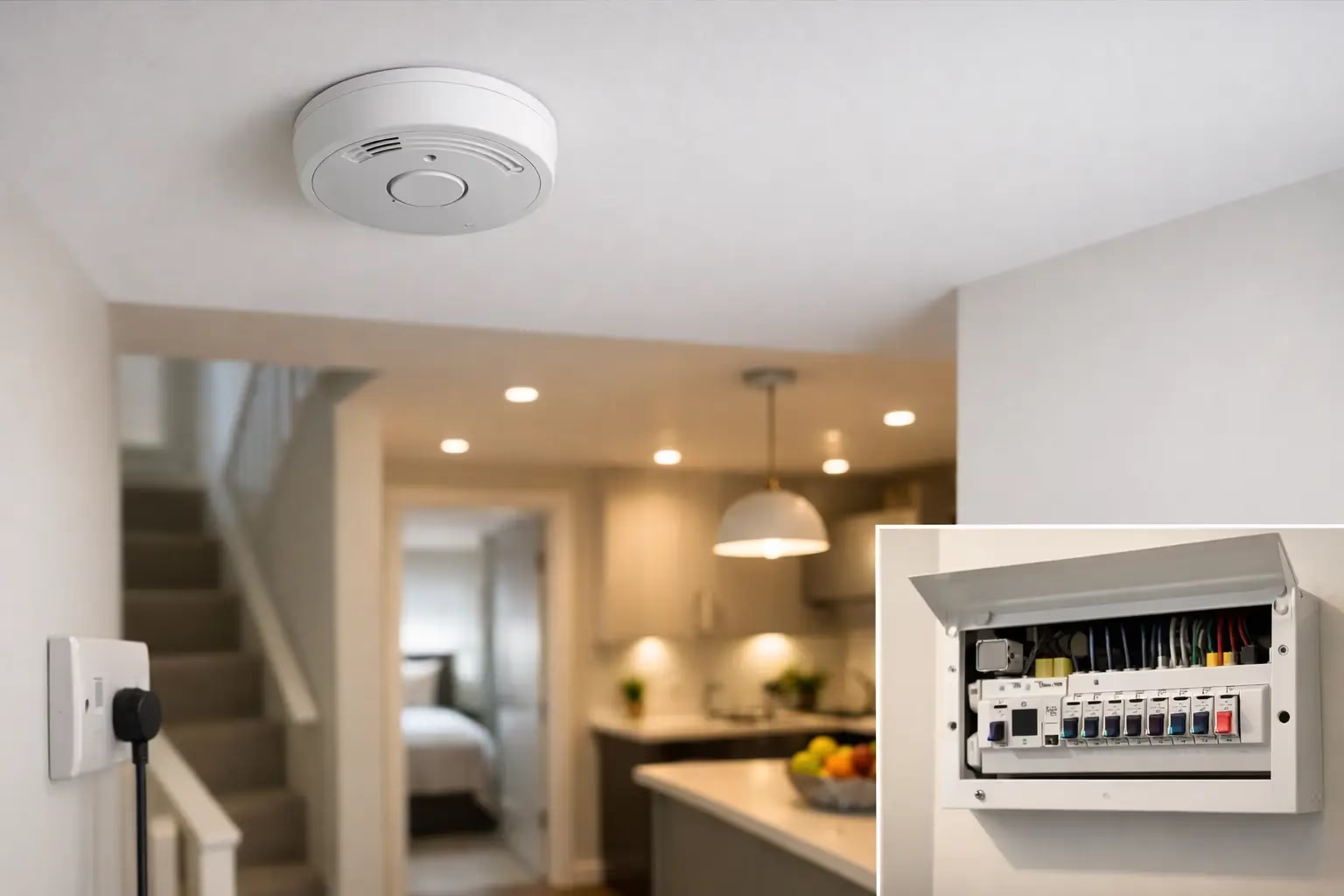
Smoke rises, which is why ceiling-mounted alarms are normally the most effective choice. Position the alarm where smoke can reach it naturally, rather than in a dead-air space near a wall, corner or beam.
A practical rule is to keep the alarm at least 300 mm away from walls, light fittings and other obstructions. Avoid placing it directly beside a ceiling fan, air vent, openable window or external door. Strong air movement can push smoke away from the sensor or introduce dust and insects that cause false activations.
On a flat ceiling, a central position within the hall, landing or room is generally suitable. If the ceiling is pitched, follow the alarm manufacturer’s instructions carefully. The very apex can trap still air, so an alarm often needs to sit slightly down the slope rather than at the highest point.
Wall mounting should only be used when ceiling mounting is impractical and the alarm instructions permit it. In that case, it should be mounted high on the wall, but not so close to the ceiling that it sits in the same dead-air zone.
Keep alarms clear of common obstructions
An alarm should not be boxed in by cupboards, positioned behind a door, or covered by decorative fittings. The same applies to exposed beams and unusually shaped ceilings. These features can interrupt the natural flow of smoke.
If you are planning a refurbishment, new lighting or a rewire, it is worth considering smoke alarm positions before the final fittings go in. It avoids an alarm competing for space with downlights, extractor vents or ceiling features later.
Where to fit extra smoke alarms
A hallway and landing arrangement is a strong foundation, but many homes benefit from additional alarms. Bedrooms are worth considering, especially where occupants sleep with doors closed, where someone may be less likely to hear an alarm, or where the property is large enough that a hall alarm could be distant from the sleeping area.
Extra smoke detection can also make sense in living rooms, home offices, utility spaces and rooms containing significant electrical equipment. The right answer depends on the room’s use, its size, and whether there is a higher chance of a fire starting there.
For example, a modern open-plan kitchen-diner creates a trade-off. A smoke alarm too close to cooking is likely to cause nuisance alarms. Yet a large open-plan area can allow a kitchen fire to spread rapidly. A correctly selected and positioned heat alarm in the kitchen zone, with smoke detection in the adjoining living or escape area, is often the more reliable arrangement.
Use a heat alarm in the kitchen
Kitchens are one of the most common locations for house fires, but they are also full of steam and normal cooking fumes. A standard smoke alarm installed too close to a hob, toaster or oven may sound regularly. That is frustrating, but more importantly, repeated false alarms can lead people to disable the unit.
A heat alarm is usually the better choice for a kitchen. It responds to a rapid rise in temperature or a set temperature threshold rather than small amounts of cooking smoke. Fit it on the ceiling, following the manufacturer’s spacing guidance and away from the immediate steam and grease plume above cooking appliances.
Heat alarms are not a replacement for smoke alarms throughout the home. They generally react later than a smoke alarm, so they are best used in rooms where smoke detection would be unsuitable, not as the only form of detection in the property.
Bathrooms and shower rooms normally do not need a smoke alarm because steam can trigger false alarms. Garages, dusty workshops and very cold outbuildings also need careful consideration. Vehicle exhaust, dust and temperature changes can make an ordinary domestic smoke alarm unreliable. A suitable heat detector may be appropriate in some cases, but the overall arrangement should be planned rather than guessed.
Interlinked alarms provide better warning
Interlinked alarms communicate with each other. If one alarm detects smoke or heat, every connected alarm sounds. This is particularly valuable in homes with more than one storey, larger layouts, loft conversions, or bedrooms some distance from the kitchen and main living rooms.
A fire starting downstairs should trigger an alarm upstairs straight away. That extra warning time can be critical at night, when a closed bedroom door may delay sound reaching occupants.
Mains-powered, interlinked alarms with battery back-up are a dependable option for many homes. Wireless interlinking can also be useful where running new cabling would mean unnecessary disruption. The best system depends on the building, the existing wiring and the scope of work. A qualified electrician can advise on a solution that is practical, tidy and suited to the property.
Do not forget carbon monoxide alarms
Smoke alarms and carbon monoxide alarms do different jobs. Carbon monoxide is colourless and odourless, so a smoke detector will not warn you about it.
A carbon monoxide alarm should be fitted where there is a fixed combustion appliance, such as a gas boiler, gas fire, log burner or solid-fuel stove. It should be installed in accordance with the alarm manufacturer’s instructions, as the correct position can vary by appliance and room layout. A gas cooker alone is treated differently under current English rental requirements, but any concerns about combustion appliances should be taken seriously.
If a carbon monoxide alarm sounds, get everyone into fresh air, seek appropriate emergency advice and do not re-enter until it is safe to do so. Never assume it is a false alarm.
Test, clean and replace alarms on time
Even perfectly placed alarms need routine attention. Test each alarm using its test button weekly, or at the interval recommended by its manufacturer. Make sure everyone in the household recognises the sound and knows what to do when it activates.
Vacuum around the alarm carefully from time to time to remove dust and cobwebs. Do not paint over it, spray aerosols near it or test it with a naked flame. Replace batteries where applicable as soon as the low-battery warning sounds, and replace the whole alarm by its stated expiry date – many domestic alarms are designed for a ten-year service life.
Landlords should check that alarms are working at the start of every new tenancy and deal with reported faults promptly. Keeping a clear record of checks and replacements is a straightforward way to demonstrate that safety has been taken seriously.
When professional advice is worthwhile
If you are unsure whether your current alarms cover the property properly, do not wait for a false alarm or a near miss to investigate. This is especially relevant after an extension, loft conversion, kitchen renovation, consumer unit upgrade or change in how rooms are used.
Gerrard’s Electrical Solutions can help homeowners and landlords around Chester assess alarm positions, install appropriate mains or interlinked detection, and explain the options in plain English. A well-planned system should be easy to live with, dependable when it matters and fitted without unnecessary disruption to your home.
Before turning in for the night, take a moment to check that your escape route is clear and your alarms are working. It is one of the smallest household checks with one of the biggest potential benefits.