

- November 5, 2026
- By
- Blog
A mains power cut is inconvenient in a home. In a workplace, communal hallway or block of flats, it can quickly become a safety risk. Emergency lighting testing confirms that the lights intended to guide people out of a building will actually work when normal lighting fails. It is a simple principle, but one that depends on regular checks, accurate records and prompt repairs.
For landlords, business owners and anyone responsible for a shared or commercial building, emergency lighting is part of a wider fire-safety duty. A light fitting that appears fine during the day may have a failed battery, damaged lamp or charging fault that only becomes clear during a test.
What emergency lighting is designed to do
Emergency lighting provides illumination when the normal electrical supply is lost. Its purpose is to help people identify escape routes, stairs, changes in level, fire equipment and final exits without having to search in the dark.
Some fittings are maintained, meaning they are lit all the time and continue operating from a battery supply during a power failure. Others are non-maintained and only switch on when the normal supply fails. Many modern units are self-contained, with a battery built into each fitting, while larger premises may use a central battery system.
The type of system affects how it is tested and maintained. However, the outcome is the same: there must be enough reliable light for people to leave safely.
Who is responsible for emergency lighting testing?
In commercial premises and the common areas of residential buildings, responsibility normally sits with the person who controls the building or has fire-safety duties. This may be a business owner, managing agent, facilities manager or landlord.
In England and Wales, the Regulatory Reform (Fire Safety) Order 2005 requires the responsible person to take suitable fire-safety measures. Emergency lighting may be required where the fire risk assessment identifies a need for it. It is not automatically necessary in every ordinary house or individual rented flat, but it is commonly needed in shared escape routes, HMOs, offices, shops, workshops and other non-domestic premises.
If you are unsure whether your property needs emergency lighting, the answer should come from the building’s fire risk assessment and the layout of its escape routes. A narrow, windowless corridor, internal staircase or large unit used after dark presents a different level of risk from a small, simple property with clear daylight exits.
How often should emergency lighting be tested?
The usual testing routine includes regular visual checks, monthly functional tests and a longer annual duration test. The exact arrangement should match the system design, the fire risk assessment and the relevant guidance, including BS 5266 and BS EN 50172.
Monthly functional checks
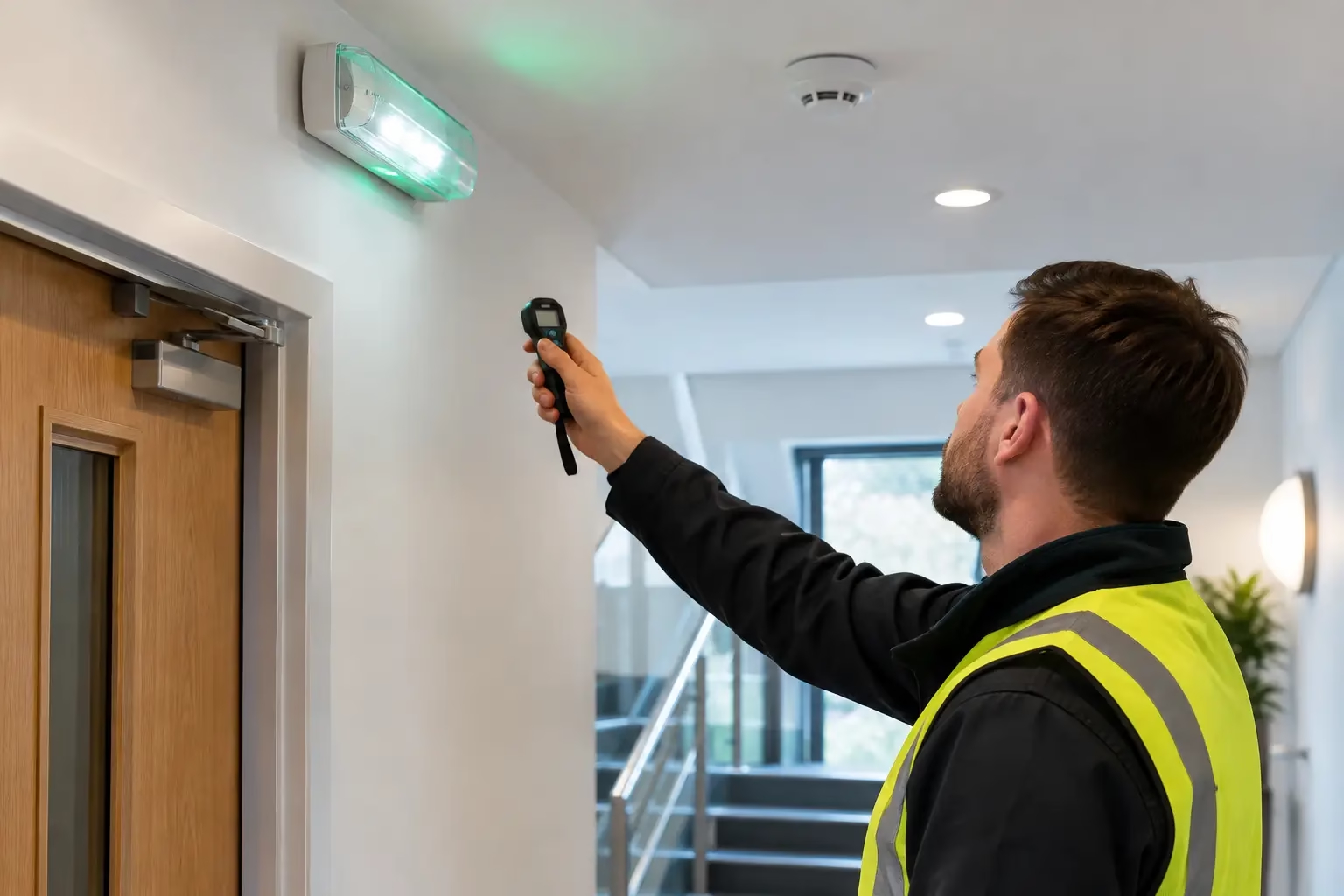
A monthly test usually involves simulating a failure of the normal lighting supply for a short period. This confirms that emergency fittings illuminate, indicator lights are showing correctly and the system changes over as intended.
The test should be long enough to establish that the fittings operate, but not so long that batteries are unnecessarily discharged. It also gives the person carrying out the check a chance to spot cracked covers, obstructed fittings, poor positioning or signs of water damage.
Annual full-duration tests
At least once a year, the system is normally tested for its full rated duration. This is often one or three hours, depending on the design. Every fitting should remain illuminated for the required period, then recharge correctly afterwards.
This test needs planning. During and immediately after a full discharge test, the emergency system may not have its full backup capacity while batteries recharge. It is sensible to carry it out at a time when the building is quiet, with suitable precautions in place. In some premises, temporary arrangements may be needed if the building will remain occupied.
Visual inspections between tests
A quick visual inspection is not a substitute for a functional test, but it is useful. Check that exit signs are clean and visible, emergency lights have not been painted over or blocked by storage, and fittings have not been damaged during decorating, building work or a leak.
Keep an emergency lighting test record
Testing without a record makes it difficult to prove that checks have been completed or to track recurring faults. A logbook, whether paper or digital, should show the date of each test, the person who carried it out, the results and any corrective work required.
Records are particularly valuable for landlords and businesses. They provide a clear maintenance history, help with inspections and make sure faults are not forgotten after a busy period. If a fitting fails, record its location precisely rather than writing a vague note such as “light not working”. That makes repairs faster and avoids repeat visits.
Common faults found during testing
A failed emergency fitting is not always obvious. The normal light in the room may still work perfectly, while the emergency battery circuit does not. Common problems include batteries that no longer hold enough charge, failed LEDs or lamps, charging faults, damaged test switches and fittings that have been isolated during other electrical work.
Older units can also become unreliable as batteries reach the end of their service life. Replacing only the battery can sometimes be the sensible option, but it depends on the age and condition of the fitting. Where several older units are failing, upgrading to modern LED emergency lighting may offer better reliability, lower running costs and clearer illumination.
Poor installation can create a separate problem. A light may operate but fail to illuminate the actual route people need to follow. Changes to room layouts, partitions, shelving or fire exits can all affect coverage. Emergency lighting should be reviewed when a property is altered, not treated as a fit-and-forget installation.
When to call a qualified electrician
Routine checks can often be completed by a trained responsible person, provided they understand the system and keep proper records. Electrical faults, failed units, alterations and full testing arrangements should be dealt with by a competent electrician.
Call for professional help if emergency lights fail to come on, charge indicators are not operating, fittings flicker or show damage, or a test reveals that lights go out before the required duration. The same applies if you have changed the use or layout of a building, converted a property into an HMO, or are unsure whether your existing system provides suitable coverage.
At Gerrard’s Electrical Solutions, we can inspect emergency lighting, identify faults clearly and carry out repairs or upgrades with minimal disruption. Work is completed carefully and in line with current electrical requirements, with straightforward advice on what needs doing and why.
Emergency lighting should never be left until an inspection is due or a fault becomes urgent. A regular testing routine, a clear logbook and timely repairs give occupants a safer route out when they need it most.