

- August 13, 2026
- By
- Blog
A tripped RCD can leave part, or all, of your home without power just when you need it most. Knowing how to reset a tripped RCD safely can help you restore electricity after a simple appliance fault, but it should never mean taking chances with a possible electrical defect.
An RCD is there to protect people from electric shock. If it trips, it has detected an imbalance in the circuit that could mean electricity is travelling somewhere it should not – potentially through damaged insulation, moisture or a faulty appliance. The switch has done its job. Your next step is to find out why before repeatedly turning it back on.
What a tripped RCD means
RCD stands for Residual Current Device. It is normally found in your consumer unit, often called a fuse board, and is usually marked “RCD” or has a test button marked “T”. It monitors the electricity flowing through a circuit. If it detects a difference that could indicate a dangerous leakage to earth, it switches the supply off very quickly.
This differs from a circuit breaker, often labelled MCB or RCBO. A circuit breaker usually trips because a circuit has been overloaded or has a short circuit. An RCD responds to earth leakage, which can be caused by a fault in an appliance, cable, socket, light fitting or the fixed wiring itself.
Modern consumer units may have RCBOs rather than one main RCD protecting several circuits. An RCBO combines both types of protection for an individual circuit. The safe process is broadly similar, but the affected switch may be a single circuit breaker rather than a wider RCD switch.
Before you reset a tripped RCD safely
Start with a quick visual and sensory check. Do not touch exposed wires, remove sockets or light fittings, or open the consumer unit cover beyond its normal switch panel. If there is a burning smell, smoke, buzzing, crackling, scorch marks, water around electrical equipment, or anyone has received an electric shock, leave the power off and contact an electrician urgently.
The same applies if the consumer unit feels hot, its cover is damaged, or you are unsure which switch has tripped. Electrical faults can develop quickly, and forcing the supply back on may make damage worse.
If there are no warning signs, switch off and unplug portable electrical items on the circuits that have lost power. Think about anything recently used: a kettle, toaster, washing machine, tumble dryer, dishwasher, iron, heater, lawn mower, extension lead or outdoor lighting. Appliances used near water and items stored in garages, sheds or outside are common sources of RCD trips.
You do not need to unplug built-in appliances or move heavy equipment if it is difficult to reach. Leave that to a qualified electrician. The priority is to avoid creating another hazard while trying to diagnose the fault.
How to reset a tripped RCD safely
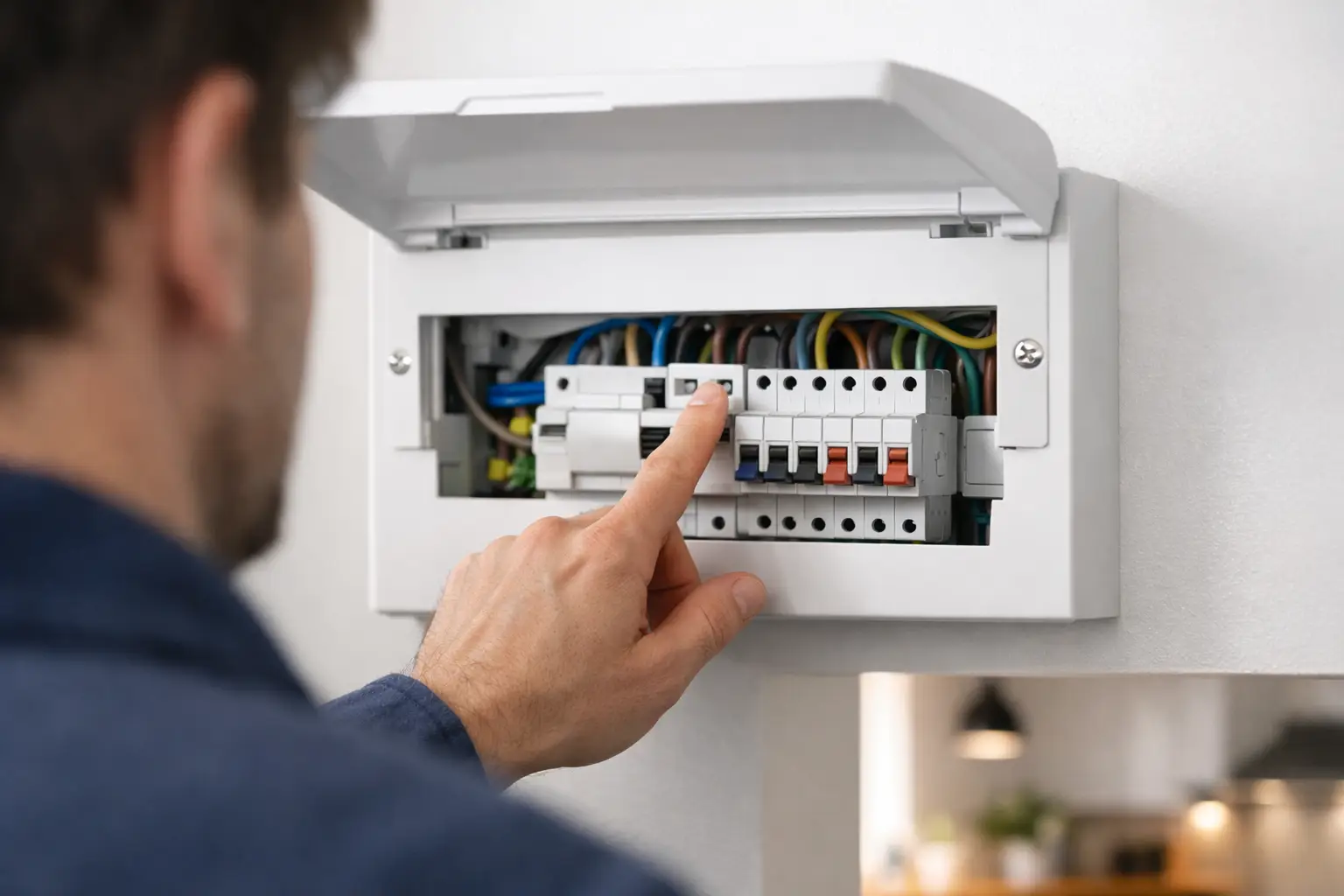
Once portable appliances are unplugged and there are no signs of danger, go to the consumer unit. Make sure your hands are dry and the area around the board is dry and well lit.
First, look for the switch that is in the down position or sitting between on and off. On many boards, the RCD switch must be pushed fully down to the off position before it can be moved back up to on. Do not force it. A firm, normal movement is all that should be needed.
If the RCD stays on, electricity should be restored to the circuits it protects. That does not prove there is no issue, but it strongly suggests one of the unplugged appliances or leads may be responsible. Reconnect items one at a time, waiting a short while between each one. If the RCD trips when a particular item is plugged in or switched on, leave it unplugged and arrange repair or replacement.
If the RCD will not stay on even with portable items unplugged, turn it back off and do not keep trying. The fault may be in a fixed appliance, an outdoor circuit, a socket, lighting circuit or the wiring. This needs proper testing rather than guesswork.
Common reasons an RCD keeps tripping
The cause is not always obvious. A washing machine may trip only when its heating element starts, for example, while an outdoor socket may trip after rain has entered a damaged fitting. A fault can also be intermittent, which is why a successful reset is not always the end of the matter.
Frequent causes include damaged appliance flexes, worn extension leads, moisture in external sockets or lights, a faulty immersion heater, a failing oven or hob, and defects in bathroom extractor fans. Ageing wiring, rodent damage, loose connections and DIY alterations can also create earth leakage faults.
A single trip after a power cut or electrical disturbance may not point to a serious defect, particularly if the RCD resets and remains stable. Repeated tripping is different. Treat it as a warning that needs investigation, especially if it happens after using the same appliance or affects a circuit without anything plugged in.
Do not bypass the protection
Never hold an RCD switch up, tape it in place, replace it with a higher-rated device, or attempt to disconnect earth wires to stop a trip. These actions remove the very protection designed to reduce the risk of electric shock and fire.
Avoid using multiple extension leads to run equipment from another circuit as a long-term workaround. Apart from creating trip and overload risks, it can hide the original problem. If an appliance is suspected, keep it isolated until it has been checked.
It is also worth remembering that unplugging an appliance does not always fully isolate it if it is hard-wired, permanently connected or controlled by a fused spur. Do not remove covers or test wiring yourself. Safe fault finding requires suitable test equipment and knowledge of the installation.
When to call an electrician
Call a qualified electrician if the RCD will not reset, trips again immediately, or trips repeatedly without a clear appliance cause. You should also arrange help if the fault affects sockets, lighting, a cooker, shower, boiler, immersion heater, outdoor power or any fixed equipment.
For landlords, recurring RCD trips should be dealt with promptly. Electrical safety duties do not stop at having a valid Electrical Installation Condition Report. A newly reported fault still needs a timely, competent response to keep the property safe for tenants.
An electrician can carry out structured fault finding rather than replacing parts at random. This may involve separating circuits, testing insulation resistance, checking earth continuity and investigating appliances or accessories under controlled conditions. The result is a clear explanation of what has failed, what needs repair and whether any wider work is advisable.
Gerrard’s Electrical Solutions provides practical fault finding and emergency electrical support across the Chester area. Work is carried out with safety, clear communication and current BS 7671 requirements in mind, so you are not left guessing whether a reset has simply masked a more serious issue.
A note on testing your RCD
Most RCDs have a test button marked “T” or “Test”. Pressing it should switch the device off, demonstrating that its test mechanism operates. Manufacturers commonly recommend testing at regular intervals, but check the instructions for your particular consumer unit and device.
Only test it when it is safe for the protected circuits to lose power. Avoid doing so while essential equipment is running, and be aware that clocks, heating controls, alarms or network equipment may need resetting afterwards. If the test button does not trip the RCD, or the device will not reset afterwards, arrange an electrician without delay.
A tripped RCD is an interruption, but it is also useful information from a safety device doing exactly what it was designed to do. Reset it carefully once, isolate any suspected appliance and take repeat trips seriously. Acting early can turn a frustrating loss of power into a straightforward repair before it becomes a larger problem.