

- August 25, 2026
- By
- Blog
A consumer unit that trips is doing an important job, but losing lights, sockets and appliances across half the property can quickly become frustrating. Understanding RCD versus RCBO protection helps explain why this happens and whether your existing fuse board is giving each circuit the level of protection it needs.
Both devices are designed to reduce the risk of electric shock and fire. The main difference is how much of your installation is affected when a fault develops. For many homeowners and landlords, that difference becomes clear at the worst possible time: when the freezer, boiler, lighting or security system goes off along with the circuit that actually has the fault.
What does an RCD do?
An RCD is a Residual Current Device. It monitors the electrical current flowing through a circuit and compares the current going out with the current returning. Under normal conditions, those amounts should match.
If some electricity is escaping from the circuit, perhaps through damaged cable insulation, a faulty appliance or a person receiving an electric shock, the RCD detects the imbalance and disconnects the supply very quickly. This additional protection can significantly reduce the severity of an electric shock.
An RCD is not, however, the same as a circuit breaker. It does not provide overload or short-circuit protection on its own. In a consumer unit, it works alongside MCBs, or miniature circuit breakers, which protect individual circuits from excessive current.
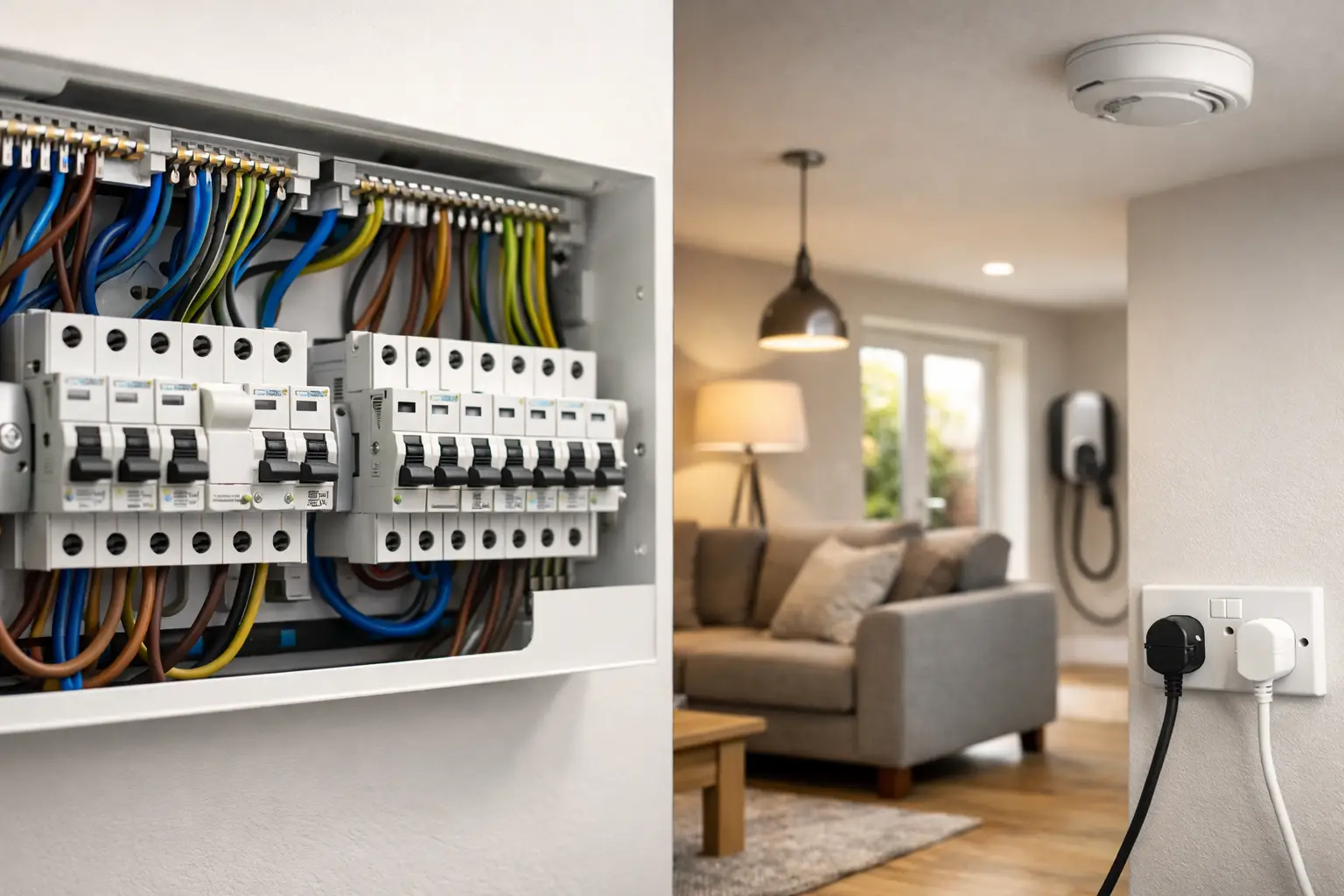
Many older consumer units use a split-load arrangement. Several MCBs are grouped under one RCD, often separating upstairs and downstairs circuits or splitting the circuits between two RCDs. This was a substantial improvement over older fuse boards with little or no RCD protection, but it has a practical limitation. A fault on one circuit can trip the RCD and switch off every circuit connected to it.
That may mean a fault with an outdoor socket also takes out indoor lights, kitchen sockets or the central-heating controls. The house is protected, but identifying the problem and restoring essential services can take longer.
RCD versus RCBO protection: the key difference
An RCBO combines two jobs in one device. It provides the residual-current protection of an RCD and the overcurrent protection of an MCB, but it does so for one individual circuit.
For example, if a washing machine on the kitchen socket circuit develops an earth leakage fault, the RCBO for that circuit should trip. The lighting, fridge circuit, boiler and other circuits protected by their own RCBOs can remain on. This is called improved circuit separation, and it is one of the strongest reasons to choose RCBO protection during a consumer unit upgrade.
In simple terms, an RCD commonly protects a group of circuits, while an RCBO protects one circuit at a time. Neither makes an electrical installation invulnerable, but RCBOs usually reduce the inconvenience and potential disruption caused by a single fault.
This matters particularly in properties with electric heating, home-working equipment, alarms, smoke alarms, freezers, fish tanks, garage supplies or outdoor power. It can also be valuable for landlords, where a fault in one flat or one part of a rental property should not unnecessarily affect other essential circuits.
Why your consumer unit keeps tripping
A tripping device should never be treated as an annoyance to be bypassed. It is responding to a condition that needs attention. Common causes include a faulty appliance, moisture in an external fitting, damaged wiring, a failed immersion heater, a deteriorating cable or too much cumulative leakage from modern electronic equipment.
With a shared RCD, the first task is often to work out which circuit is causing the trip. This can involve safely switching circuits off, resetting the RCD and bringing circuits back on one at a time. Even then, the fault may only appear when a particular appliance is plugged in or when rain affects an outside light or socket.
RCBOs make the affected circuit more obvious, but they do not diagnose the underlying fault. If an RCBO repeatedly trips, do not keep resetting it in the hope it will stay on. Unplug portable appliances on that circuit where safe to do so, leave the circuit isolated if the problem continues, and arrange for a competent electrician to investigate.
Burning smells, buzzing, scorch marks, shocks from metal fittings or a consumer unit that feels unusually warm require prompt attention. If there is immediate danger, isolate the supply if it is safe to do so and seek emergency electrical help.
Is RCBO protection always the better choice?
For most modern domestic consumer units, individual RCBOs are often the preferred arrangement because they provide a high level of protection and limit disruption. They are especially sensible where continuity of supply matters, such as for refrigeration, heating controls, security equipment and lighting.
There are still trade-offs. RCBOs generally cost more than a basic split-load RCD arrangement, particularly where every circuit is being upgraded. The condition of the existing consumer unit, the number of circuits, available space and the type of supply all affect what is suitable. In some cases, fitting RCBOs into an old board is not appropriate or cost-effective, and replacing the consumer unit may be the safer long-term option.
The quality of the installation matters as much as the devices chosen. A new consumer unit must be correctly designed, installed, tested and certified to current BS 7671 requirements. It should also be selected to suit the property rather than treated as a like-for-like box swap.
An electrician may recommend additional protection too, such as surge protection devices or arc fault detection devices, depending on the installation and risk assessment. These have different roles from RCDs and RCBOs. They should not be confused with a cure for damaged wiring, loose connections or faulty appliances.
RCD types and why they matter
Not all RCD protection is identical. Modern homes contain induction hobs, washing machines, EV chargers, solar equipment, LED drivers and other electronic devices that can affect the type of residual-current protection required.
Type A devices are commonly used in domestic installations because they are designed to deal with the types of residual current produced by much modern equipment. Some specialist equipment may require a different arrangement, based on the manufacturer’s instructions and the electrical design. This is one reason a proper assessment is better than choosing devices simply because they are cheaper or readily available.
The circuit itself also needs consideration. Outdoor sockets, bathrooms, garages, kitchens and circuits supplying equipment outside the home can have particular requirements. A competent electrician will check earthing, bonding, cable condition, circuit loading and protective-device ratings before recommending an upgrade.
When should you consider a consumer unit upgrade?
A consumer unit upgrade is worth discussing if your board has rewireable fuses, no RCD protection, frequent unexplained tripping, visible damage, outdated components or insufficient capacity for planned work. It may also be the right time when adding an electric shower, EV charger, extension, new kitchen, garden office, solar system or substantial new circuits.
For landlords, electrical safety is not only about keeping tenants comfortable when something trips. Private rented properties in England require a satisfactory Electrical Installation Condition Report at least every five years, or sooner if the report recommends it. An EICR can identify concerns with an ageing consumer unit, inadequate protection or faults elsewhere in the installation.
Homeowners can also benefit from an EICR where the installation is older, a property has been purchased recently, or there are recurring electrical issues. It provides evidence-based advice rather than guesswork about whether an upgrade is needed.
Testing and looking after RCDs and RCBOs
Most RCDs and RCBOs have a test button. Pressing it should cause the device to trip, showing that its test mechanism operates. Follow the manufacturer’s instructions and any advice provided with your installation for how often this should be done.
A successful button test does not prove that every part of the electrical installation is safe. It does not test cable condition, loose connections, damaged accessories or whether the device will operate correctly under all fault conditions. Professional testing remains essential during an EICR, consumer unit replacement or fault-finding visit.
Avoid covering the consumer unit with stored items or boxing it in where access becomes difficult. Keep the circuit labels clear, and take repeated tripping seriously. Clear labelling is particularly useful for landlords and families, as it helps identify what has been safely isolated while waiting for an electrician.
For properties across Chester and the surrounding area, Gerrard’s Electrical Solutions can assess your existing consumer unit, explain the options in plain English and carry out compliant upgrades with tidy, tested workmanship. The right choice is not simply RCD or RCBO – it is protection designed around the circuits, equipment and people in your property, so a fault is dealt with safely without causing more disruption than necessary.